Open Transaction Networks and Platform Competition
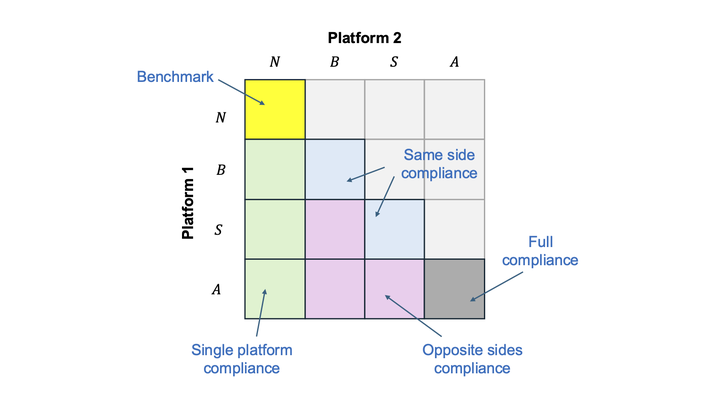 Compliance regimes when each platform opens neither side (N), the buyer side (B), the seller side (S) or all sides (A)
Abstract
This paper studies Open Transaction Networks (OTNs), open protocol-based networks in which buyers and sellers connected through independent applications can transact with one another. India’s Open Network for Digital Commerce (ONDC) is the leading real-world instance. We develop a two-sided Hotelling model in which two competing platforms choose whether to adopt the shared protocol on the buyer side, the seller side, both sides, or neither. Existing theory suggests that platforms typically underinvest in interoperability. We show that full interoperability between competing platforms can instead emerge as the equilibrium outcome of platform competition.
In brief
Open transaction networks let buyers and sellers on different apps transact with one another through a shared protocol, as India’s Open Network for Digital Commerce and Namma Yatri do for retail and mobility. The question for governments is whether platforms will join such networks voluntarily or need to be mandated to do so.
We model two competing platforms that choose whether to open their buyer side, their seller side, both or neither to the network. Existing theory suggests that platforms typically underinvest in interoperability, and we show that full interoperability can instead emerge as the equilibrium of platform competition.
The paper is part of the Economics of Open Transaction Networks programme at the Global Development Network, funded by the Gates Foundation, which is taking the model to transaction data from five implementations in India, Brazil and East Africa.

Kishen Shastry
Economist | PhD, University of Cambridge
Economist with a PhD from the University of Cambridge and Postdoctoral Research Associate at the Cambridge Centre for Alternative Finance, working on development economics, the economics of religion and informal institutions, political economy, and the economics of digital technologies and platforms.