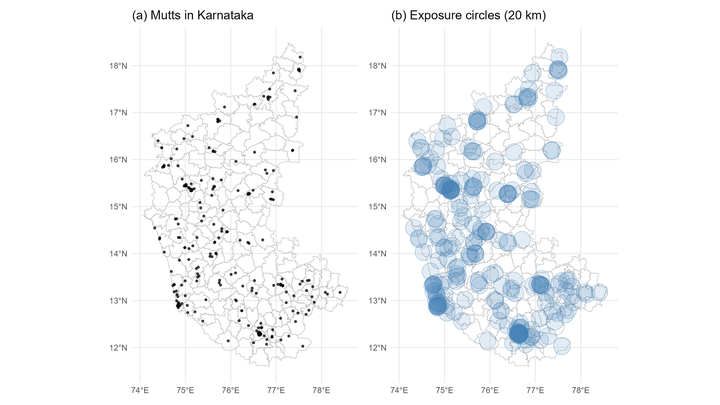
 Mutts in Karnataka and 20 kilometre exposure circles
Abstract
Hindu monastic institutions (mutts) in Karnataka run schools, colleges and hostels, and their heads carry weight in state politics. We study how these institutions shaped local responses to India’s economic and political reforms of the early 1990s. We build a new geocoded dataset of 253 mutts and link it to subdistrict panels from the Economic Census and Population Census and to assembly election results. Using a difference-in-differences design with continuous pre-1990 mutt exposure, we find that more exposed subdistricts added more non-farm jobs after the reforms: 15-20 percent more in our preferred estimates, mostly in manufacturing and private firms. Government employment barely changed. The employment gains are absent in 1998 and appear by 2005. More exposed subdistricts also gained more secondary schools and colleges per capita, and more exposed constituencies had narrower victory margins after 1994, with no detectable change in turnout or the number of parties. These patterns are consistent with mutts both running educational institutions and acting as political intermediaries.

Kishen Shastry
Economist | PhD, University of Cambridge
Economist with a PhD from the University of Cambridge and Postdoctoral Research Associate at the Cambridge Centre for Alternative Finance, working on development economics, the economics of religion and informal institutions, political economy, and the economics of digital technologies and platforms.